What is Kashmir Shaivism?
What is Kashmir Shaivism?
Welcome to Kashmir: The Forehead of Mother India
This is an invitation to travel to Kashmir. To walk its verdant valleys, to see its shimmering lakes and to exhale in the ancient city of Srinagar, city of the Goddess. You can travel there through image, through senses and through its fertile history as the birthplace of Kashmir Shaivism.
Srinagar is set around a crystal lake and surrounded by sloping snow capped mountains. At dusk, the peaks are kissed with peachy sunlight. It was known in antiquity as the Tilak, marking it as the blessing on the forehead of Mother India.
For centuries, Srinagar was a scholarly city where philosophy and poetry were not separate pursuits. This convergence of theory and poetry birthed the rasas, flavours of aesthetic experience which are central to Classical Tantra. Today, despite long-worn conflicts on Kashmir's autonomy and much brutality against its inhabitants, her magnificent beauty still shines. This is the birthplace of worship of the Goddess through tasting her flavours in all of reality.

Srinagar, City of the Goddess.
What Kashmir Shaivism Actually Is: Meet the Teachings in Practice
Kashmir Shaivism was born in the second period of the unfolding of Shaiva Tantra. The first phase included anonymous, mysterious and practice-focused scriptures where Tantric wisdom was received directly from Shiva and Shakti, expressions of the singular divine consciousness at the centre of the tradition. The second phase, now known as Kashmir Shaivism, was a period spanning the tenth and early eleventh centuries where those scriptures were studied, practiced and expanded upon by deeply devoted masters of philosophical and spiritual traditions, mostly based in Kashmir.
The term Kashmir Shaivism comes to us from the western reception of these ideas; where these teachings were initially received as philosophy alone, separated from the practice tradition that gave them life. But what the term actually points us back to is something far beyond theory. Kashmir Shaivism is a collective of brilliant, often awakened masters whose primary concern was to articulate how consciousness creates the reality of our moment to moment experience.
To study and enter into the lineage of Kashmir Shaivism is to perpetuate the wisdom of these masters. Not by postulating new theories of enlightenment, consciousness and the nature of reality, but by meeting the essence of these teachings in practice, in direct and devoted lived experience.
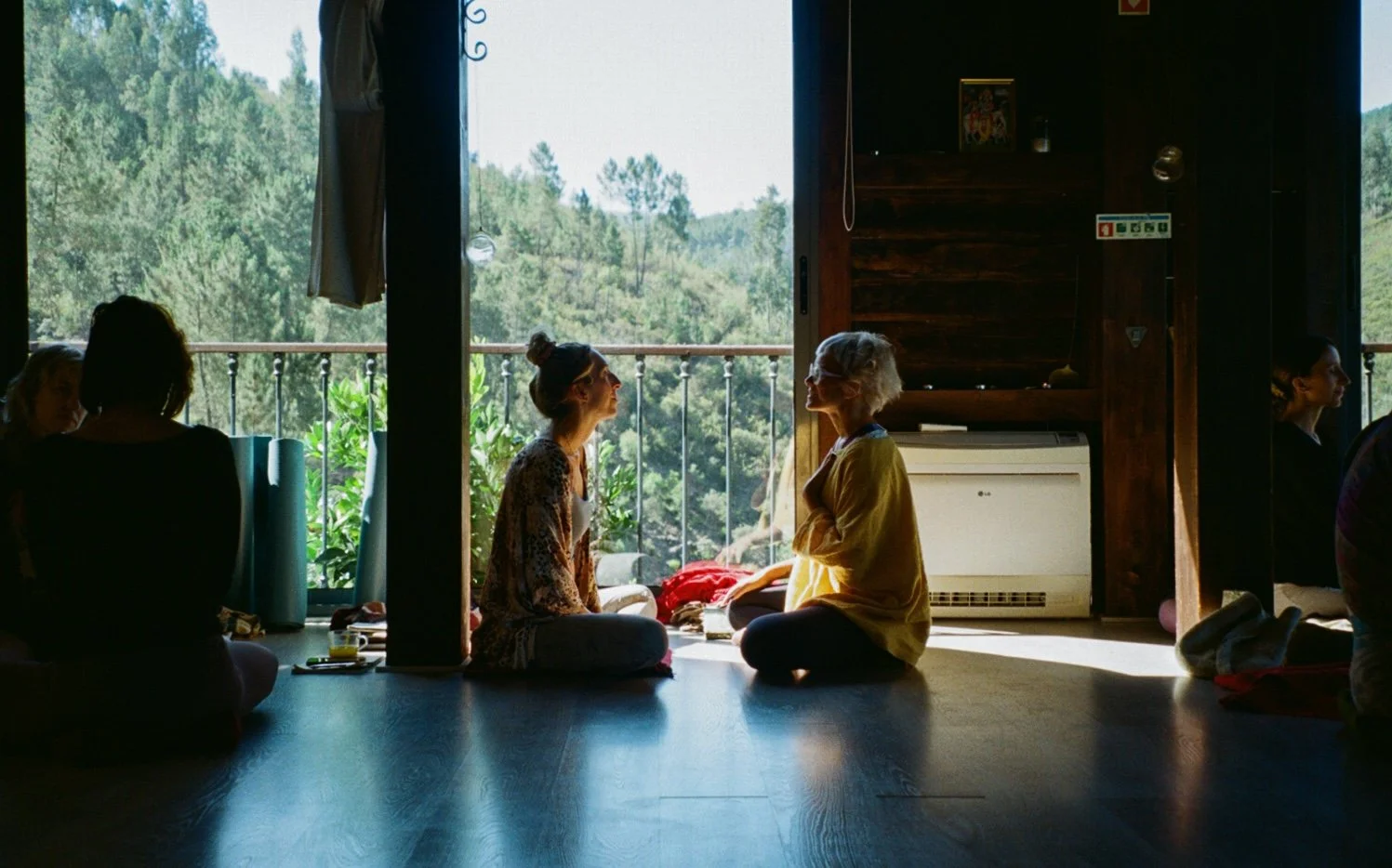
Meeting the essence of Kashmir Shaivism in practice.
The Lineages of Kashmir Shaivism: An Alive Line of Transmission
There are different limbs, lineages and lores within Kashmir Shaivism. What unifies them is the tradition of transmission. Kashmir Shaivism is a living story of awakening that has always been passed from teacher to student, body to body, practice to practice.
Within this tradition, three key lineages are worth naming. The Spanda lineage of divine vibration, the Pratyabhijñā lineage of recognition, and the Trika and Krama traditions of Shiva, Shakti and individual soul where awakening is experienced within a sequential path of practice. These strands were woven together by Abhinavagupta, the sage whose synthesis of these three lineages remains the most complete the tradition produced.
The story of the Spanda lineage begins with Vasugupta (c. 875-925 CE), who received a dream in which he was shown scripture carved into a stone on Mount Mahādeva in the Kashmir Valley. He went and found the stone in waking life and upon it were carved the aphorisms now known as the Śiva Sūtras, the seed teachings of Spanda. This is an understanding of God as the vibrant pulsation of consciousness moving through endless waves of contraction and expansion.
The Pratyabhijñā lineage begins with Somānanda (c. 900-950 CE), a master who wrote from a state of felt oneness with the divine. Where most authors of spiritual texts begin with a homage to God, Somānanda could not as he experienced no separation between himself and Śiva. His invocation instead asks the divine to honour itself through him:
The Lord Śiva of contented awareness is the very Self vibrating in all things, his will flowing freely and his knowledge and action expanding everywhere.(Translation from Tantra Illuminated, see reference at bottom of page)
Central to Somānanda's teaching was his articulation of the six Powers of the Divine: Awareness (cit-śakti), Bliss (ānanda-śakti), Freedom (svātantrya-śakti), Willing (icchā-śakti), Knowing (jñāna-śakti) and Acting (kriyā-śakti). In the Tantric view, a devoted practitioner does not merely contemplate these powers, they embody them. This is where the term 'recognition' becomes important; when we open ourselves up to the undeniability of our own powers, then the divine recognises itself in itself. Everything is absorbed into that recognition.
Somānanda's disciple Utpala Deva (c. 925-975 CE) wrote the Stanzas on the Recognition of the Divine, one of the most important texts in the tradition. Abhinavagupta (c. 975-1025 CE) - the most prolific and influential writer the tradition produced - later wrote the definitive commentary on those stanzas, drawing together the Spanda, Pratyabhijñā, Trika and Krama lineages into a single, coherent and living body of teaching.
His disciple Kṣemarāja distilled this vast inheritance into its most accessible form: the Pratyabhijñāhṛdayam, or The Heart of the Doctrine of Recognition. In twenty sūtras with his own commentary, Kṣemarāja brought the wisdom of these lineages into direct practice. This text has been translated into English by Hareesh Wallis and is one of the central transmissions we immerse ourselves in on the Samāveśa 250 Hour Tantra, Somatics and Embodied Yoga Facilitator Training (full reference at the bottom of the page).
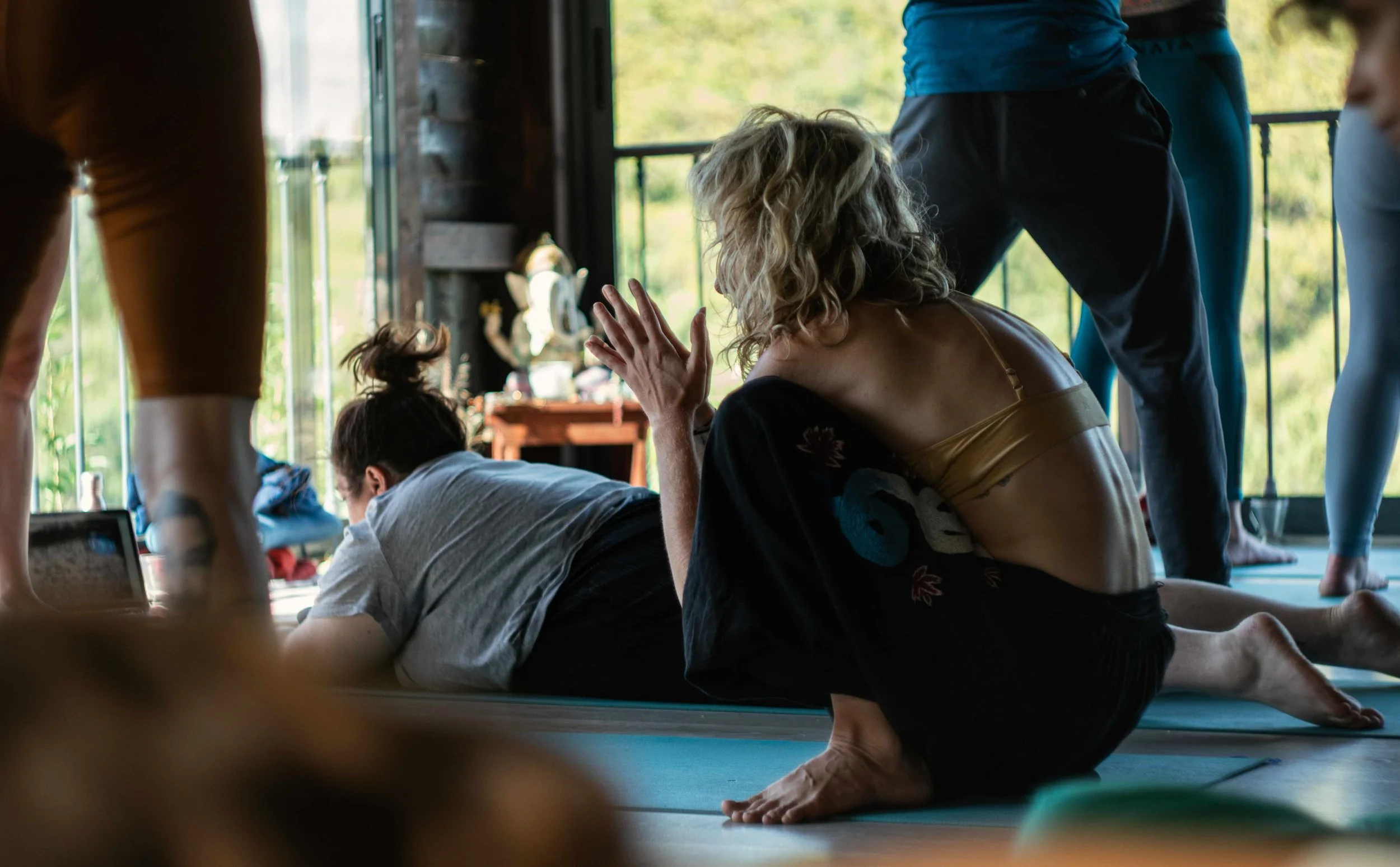
Camatkara: the endless expansion and awe that floods when the divine recognises itself.
Spanda: Pulsation as Living Practice
Kashmir Shaivism both reveres the masters of its lineages and also entrusts their wisdom to live within the bodies of successive waves of new practitioners. So with full reverence to Vasugupta, Somānanda and Utpala Deva, let's slip right into the living transmission of Spanda.
Open your left palm and invite your awareness - the locus of your attention - to rest in that hand. What do you feel? Follow both the sensations happening in your hand and the quality of your experience when you stay close to them. Notice the difference between that and the urge to control, or to place thought over the moment by moment experience of awareness centred in the palm.
If a thought does arise and begins to close over the experience, notice what it does to it. And as you notice how thought begins to close over sensation, let your fingertips curve in towards your palm, beginning to grip the open air, the open space. Then draw your bones, your knuckles, your joints inwards until your fingers are clenched tightly into your palm. Pull tighter and tighter.
Take your other hand and try to pull those fingers open whilst your left hand resists. Notice how it tightens further against the loosening. Stay with the sensations of that clenched fist for some time. Feel what it is to be in this state of held tightness.
Then, when you are ready, take your right hand and very gently let the fingertips, the skin of your right palm, kiss the skin of your left. What happens when that clenched fist is met by soft touch? Let it take the time that it takes. Begin to witness the left hand gently releasing and softening into the holding of your right.
Slowly let that left hand open all the way back out until both palms are facing upwards and open. Notice the sensations in your hands now. See if you can magnify that feeling of openness, of expansiveness, until it moves out of your hands and up your arms, into your shoulders, rippling through your whole body and out into the field of space around you.
This is a living transmission of Spanda. The contraction is concealment, the soft touch of the right hand is grace. The opening is revelation. This is the heart of the Spanda lineage and all that the masters of Kashmir Shaivism were devoted to articulating through ‘Tantras’, the texts they produced to pass the lineage on.
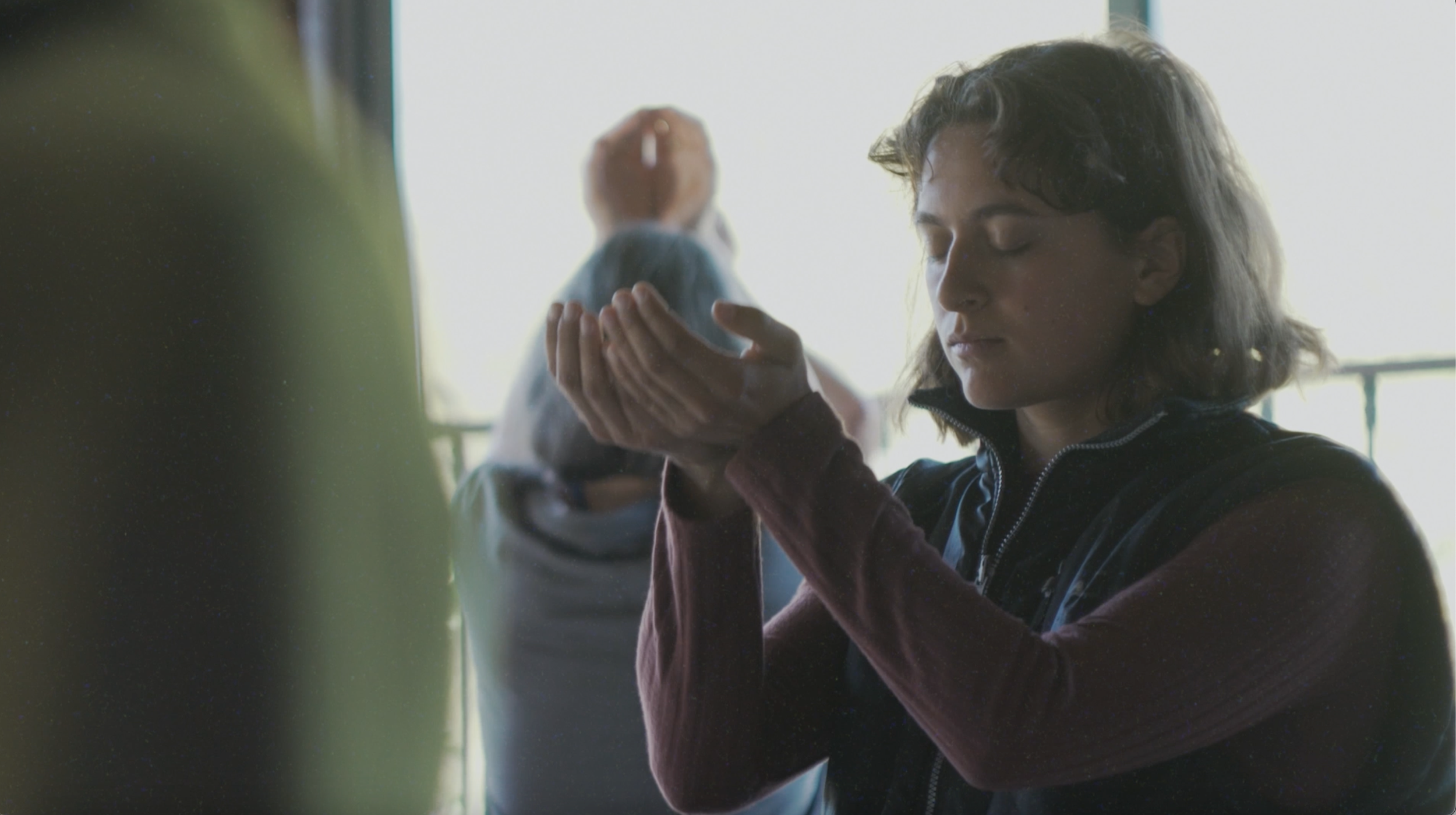
Opening to revelation through meeting the teachings in alive transmssion.
Kashmir Shaivism as Aesthetic Philosophy
The Spanda teachings were expanded upon by Abhinavagupta through his identification of the nine rasas, particular flavours of aesthetic experience. For Abhinavagupta, this was not a separate inquiry from his Tantric philosophy. Beauty and liberation were the same doorway.
Whilst any and all experience can give the felt sense of Spanda (expansion and contraction), Kashmir Shaivism explores the idea that the divine is particularly enraptured by experiences that heighten aesthetic awareness, and that such experiences heighten the practitioner's capacity for Pratyabhijñā - for direct recognition of the divine experiencing itself.
A rasa is not an object of awareness (be it a rose, a cloud or a particularly well-rounded rock) but the feeling evoked within us when we engage with the aesthetics of things. The nine rasas are: the erotic (śṛṅgāra), the disgusting (bībhatsa), the terrifying (bhayānaka), the comic (hāsya), the wrathful (raudra), the peaceful (śānta), the compassionate (karuṇā), the heroic (vīra) and the astonishing (adbhuta). These rasas are all flavours of consciousness that we experience when we engage with art. They are different qualities of our reactions to beauty.
This is why Kashmir Shaivism is said to be an aesthetic philosophy; it is through coming into relationship with sense objects that invoke rasa - tangible reactions to beauty - that we open the doorway for recognition to flood back in. We open the doorway for the divine. And we all do this, all of the time. Think about the last time you deeply engaged with a work of art, what rasa did you experience?
Eroticism, Divinity and The City of the Goddess
And this lands us back in place. In the beauty of the place from which these ideas, these practices and these lineages were born. Srinagar evokes a rasa. Perhaps you can sense it, even from the name, the word, which of course is also the word for the flavour of aesthetic experience we call erotic, which in Sanskrit is śṛṅgāra.
And it's this word, eroticism, which can confuse things when it comes to Tantra. Kashmir Shaivism, and all practices of traditional Tantra, do not focus on sexuality as a means of awakening. When Kashmir Shaivism speaks of eroticism as a means for the divine to experience itself, it is not giving practices such as Yoni Massage or any overtly sexual act as a means to do this. Whilst of course, sex and sexual practices can be gateways, as can everything, to reduce Tantra to this alone negates centuries of devoted study, practice and transmission.
The eroticism of the root rasa śṛṅgāra is the bloom from which all other rasas flower. It seeks to point us to the fundamental orientation of consciousness towards beauty, aliveness, pleasure. To only see this as sex and sexuality is to narrow the focus of all of life and deny so many exquisite doorways to śṛṅgāra. This is what and where the tradition of Kashmir Shaivism was born from and into. At Samāveśa, we are devoted to continuing that tradition by looking for, and showing one another, the doorways that open to recognition of the divine, everywhere.
Open the door.
Explore our 250 and 300 Hour Embodied Yoga Trainings and continue the living transmission of Kashmir Shaivism.

Srinagar: What rasa do you taste when you sense Her?
References and further reading on Kashmir Shaivism
Wallis, C. (2013). Tantra Illuminated The Philosophy, History, and Practice of a Timeless Tradition. Mattamayura Pr.
Wallis, C. (2017). Recognition Sutras. Mattamayura Press.
